

How to Verify the USDT TRC-20 Contract Before a Transfer
Check the genuine USDT contract against Tether's official listing, understand source-code verification and distinguish a contract from a deposit address.
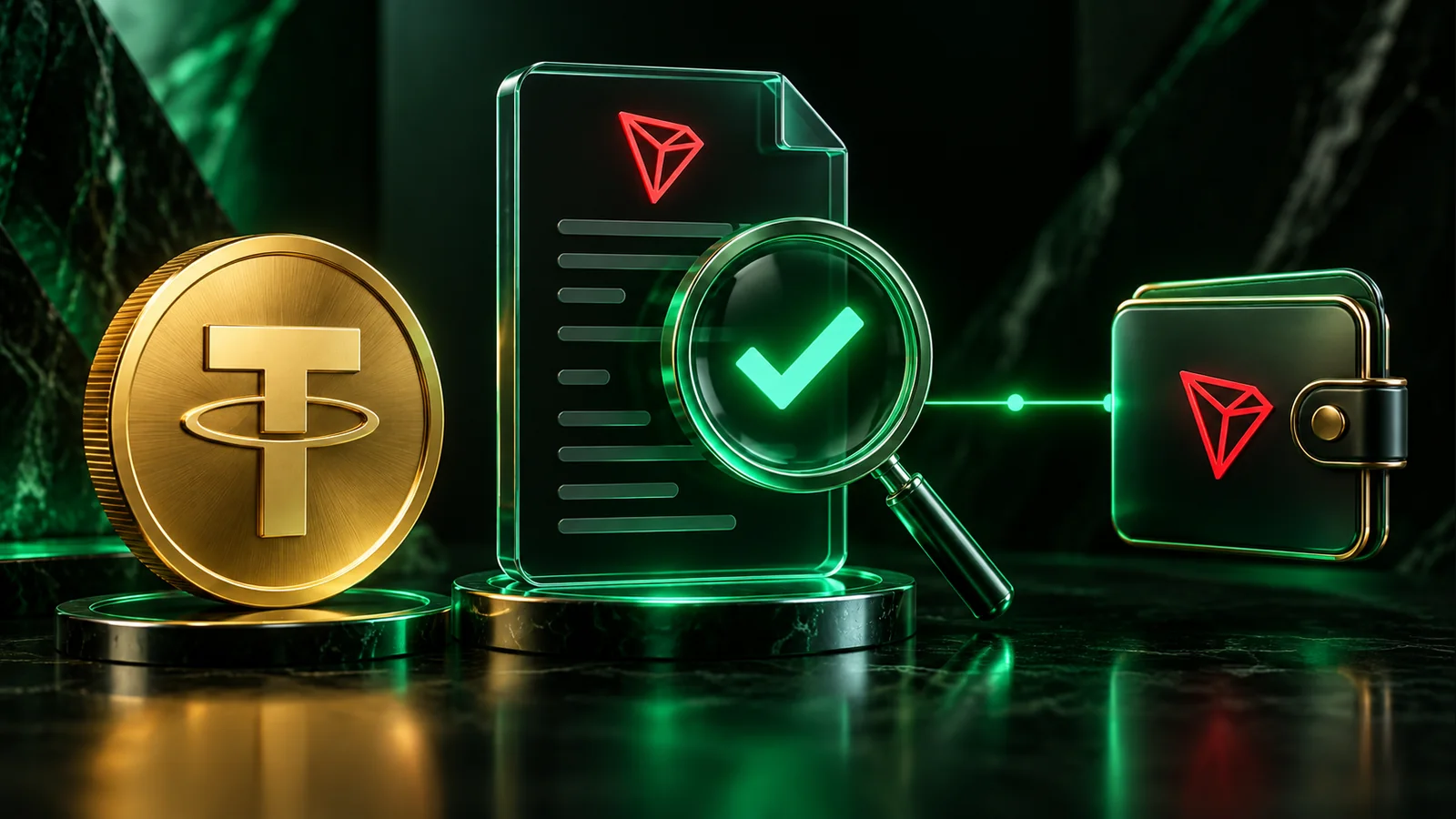
Checking USDT on TRON means verifying the token's contract, not just its name or icon. Anyone can display a familiar ticker on another token. Use Tether's official contract reference, then inspect the same address in TRONSCAN and in your wallet.
Start with the issuer's reference
Tether lists USDT on TRON under TRC-20 in its supported protocols page. At the time of this guide's review, the listed TRON USDT contract is TR7NHqjeKQxGTCi8q8ZY4pL8otSzgjLj6t.
Use that page as the current reference and follow its explorer link. Compare the full contract address with the token details in your wallet. Do not rely only on the first characters, a search advertisement or a token's claimed dollar value.
Understand what contract verification proves
Source-code verification compares submitted contract source with deployed bytecode and makes matching source available to inspect. TRON explains that process in its contract verification documentation.
A verified-source label does not by itself prove that a token is Tether's USDT, that its issuer is trustworthy or that an interaction is risk-free. Token identity still requires comparison with the issuer's exact network and contract reference.
Keep three addresses separate
For an ordinary USDT transfer, distinguish the token contract, the sending wallet and the receiving wallet. The contract defines the token logic; the sender holds the balance being spent; the recipient receives the tokens.
For the TronBid exchange, copy the receiving address from the current exchange page. Do not paste the USDT contract into the recipient field as a substitute. Likewise, an Energy rental target should normally be the USDT sending wallet, not the token contract.
Check the network before importing a token
Adding a token to a wallet's display does not move funds between networks. A USDT contract on another blockchain is not the TRON contract, even if the ticker matches.
Read TRC-20 versus ERC-20 before using a deposit or exchange route. Adding the correct token display may reveal an existing balance, but it does not create a balance or recover a transfer made on the wrong chain.
Inspect a suspicious incoming token
If an unexpected token appears, compare its contract with the issuer's reference before trying to use it. A displayed amount or unsolicited transfer is not proof of equivalent USDT value.
You do not need to sign a transaction to read an address or transaction record in an explorer. Treat any request to approve unrelated spending, reveal a seed phrase or pay to unlock a token as a separate action to investigate, not part of a simple contract lookup.
Verify the outgoing transfer
Before signing, check the wallet's selected token, network, recipient and amount. After sending, open the TXID and inspect the token transfer and execution result using the TRON transaction checklist.
If genuine USDT is present but the wallet cannot send it, the next question may be resources rather than authenticity. The insufficient TRX guide explains that separate issue.